

Shangarh, Sainj Valley: The Meadow Himachal Forgot to Show You
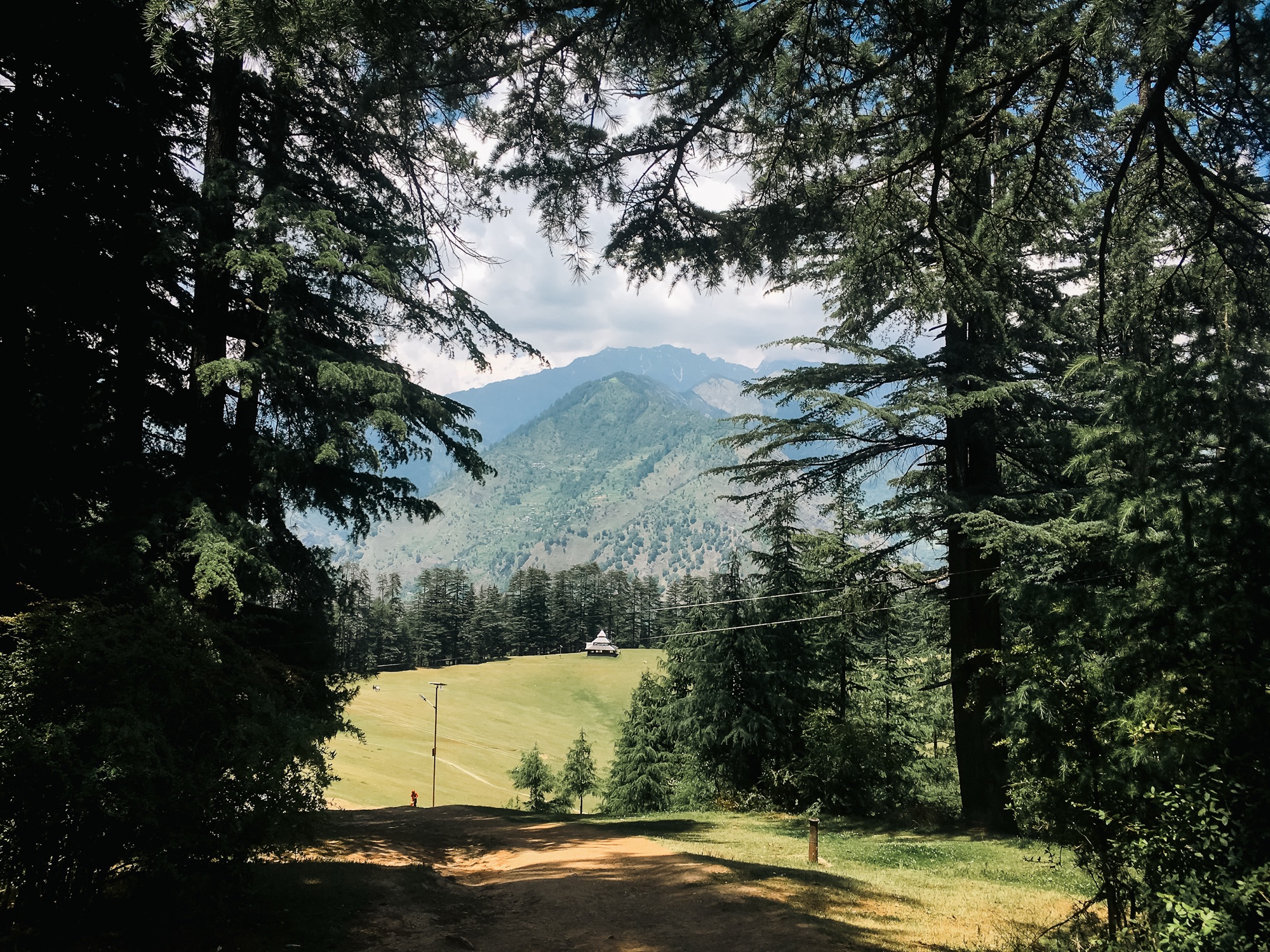
Most people mispronounce it as “Shangarh.” The name actually means splendour. Stand in the meadow here at golden hour, with the Shangchul Mahadev temple catching the last light and the peaks fading to blue behind it, and you stop questioning why.
Legend says the Pandavas cleared this land during their exile some 5,000 years ago, sieving out every stone by hand to grow rice — which is supposedly why you still won’t find a pebble here no matter how deep you dig. After they left, the story goes, demons moved in, until Shangchul Mahadev arrived from Kinnaur and drove them out. He’s said to have claimed the meadow for himself and settled at its edge, inside a wooden temple the village has grown up around ever since.
Shangarh is also the quiet launch point for a string of treks into the Great Himalayan National Park — a UNESCO World Heritage Site most travellers to Himachal never even hear about.
We first walked into this meadow about ten years ago, and calling it “hidden” back then would’ve been an overstatement — it wasn’t hidden, it just wasn’t on anyone’s list. There wasn’t a homestay in sight. No signage pointing you toward the temple, no one waiting to tell you the Pandava story for the hundredth time that week. The meadow belonged mostly to the village itself — a picnic spot for local families on a free afternoon, a place kids ran around in while the elders sat near the temple steps. You’d occasionally cross a trekker headed further into GHNP, but that was about it. Ask around Kullu today and Shangarh comes up in the same breath as Tirthan and Jibhi — everyone’s “hidden gem” now has a homestay booking link attached to it. It’s still beautiful, still worth the drive, but there’s a particular kind of quiet we got to stand in a decade ago that isn’t really available anymore. Worth knowing before you go in expecting an undiscovered secret.
Where Is Shangarh Located?
Shangarh sits in the Sainj Valley of Himachal Pradesh, roughly 6,300 feet above sea level, ringed by the Shensar, Banaugi, Shangarh, and Shaktimaror peaks — right inside GHNP’s eco-zone.
How to Reach Shangarh from Delhi and Chandigarh
Head toward Mandi and on to the Aut tunnel — about 470–500 km from Delhi, 10–14 hours by road. Just before Aut, turn right onto the Larji–Sainj road. From there, it’s Sainj town, then Deohari, Neahi, and the Ropa forest complex, before a final diversion near Neuli climbs up to the village.
No car? Bus to Aut, shared taxi to Sainj, another shared ride up to Shangarh. Bhuntar Airport is the nearest airport (about 60 km), Joginder Nagar the nearest railhead (roughly 150 km) — a taxi covers the rest either way.
Best Time to Visit Shangarh
March to June is the sweet spot — clear skies, mild days, the meadow at its greenest. Skip the monsoon; the roads turn treacherous. Winter (November to March) brings snow and a real sense of isolation, worth it if you don’t mind the cold and the harder access.
The Shangchul Mahadev Temple
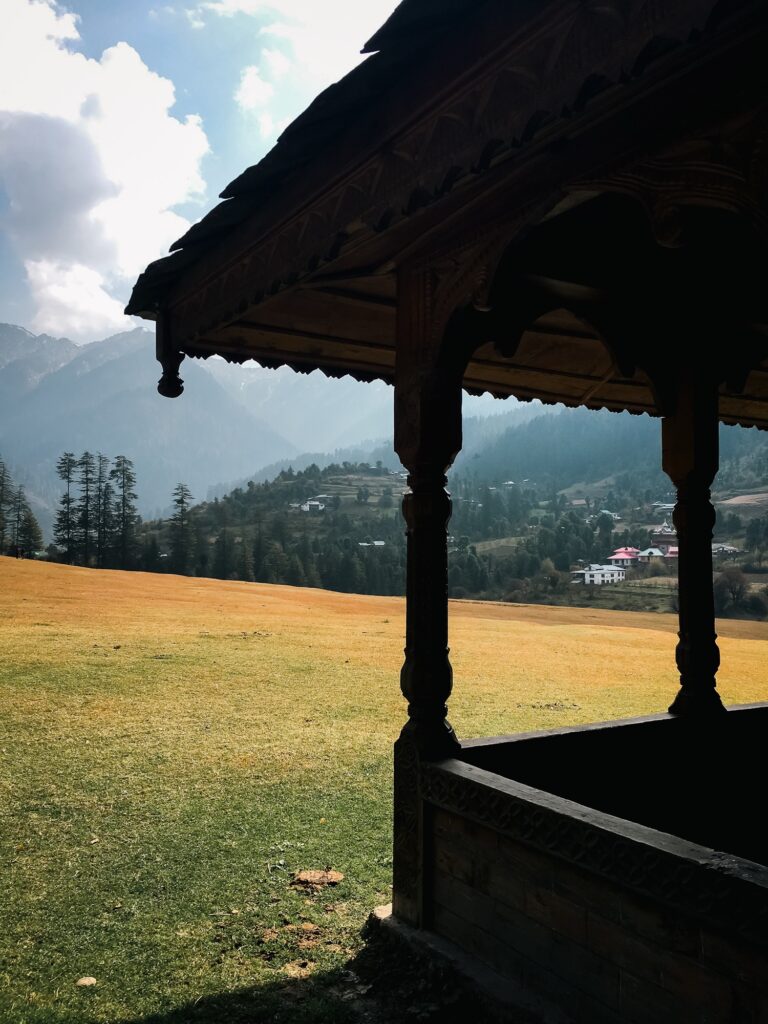
This small, intricately carved wooden shrine is Shangarh’s actual centre of gravity — more than the meadow, more than any viewpoint. Locals consider Shangchul Mahadev the village’s protector, and that’s not a tourist line; it shows in how often people are actually at the temple, not posing for it.
It’s a short, scenic walk from the village — about a kilometre, twenty minutes, part of it alongside a stream. Monday’s the most auspicious day to visit, being sacred to Shiva. The original structure burned down some years back; the village rebuilt it almost immediately, which tells you everything about what this place means here.
The Stone-Free Meadow
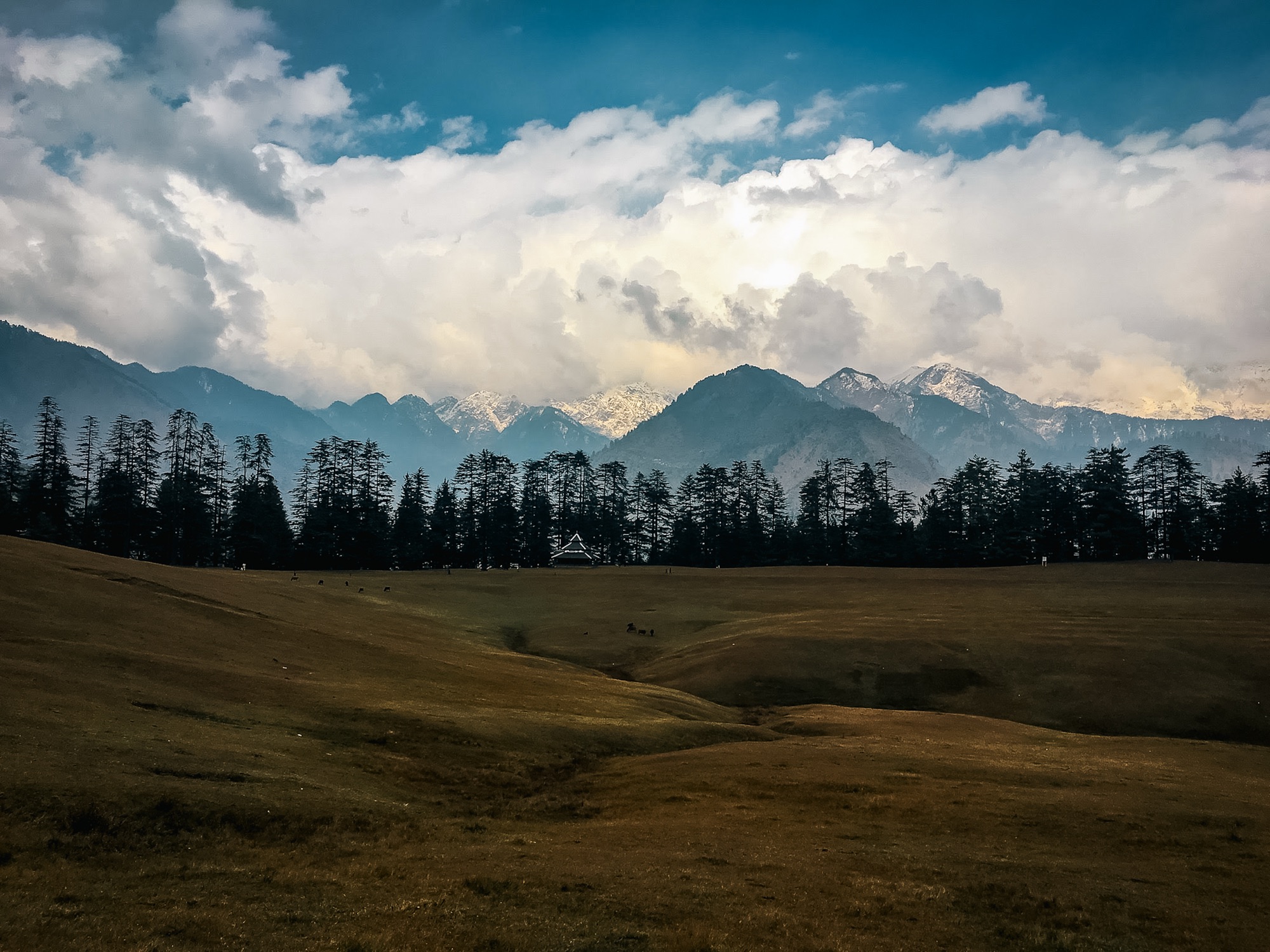
Locals call it Shangarh Thatch, and the first thing everyone says on seeing it is that it looks like a golf course — smooth, green, ringed by pine, the temple standing watch at one edge. Nothing gets built or farmed on the open ground in front of it; it’s kept sacred, reserved for the deity and for festivals. Some British officers apparently tried turning it into an actual golf course once. The village said no. It’s stayed a meadow ever since.
Wood Carvings, Old Stone, and Stories Nobody Wrote Down
The temple’s beams are covered in detailed carvings of gods and mythological scenes, worked by hands taught the old way — by someone older, who learned it the same way before them. Older stone statuary sits alongside it, weathered but intact. None of this history is written down anywhere official. It survives the way most things survive in the hills: passed on, told again, performed the same way every year without anyone needing a manual.
Village Culture and the Local Mela
Kullu is called the Valley of Gods, and Shangarh takes that literally — nearly every village here has its own deity and its own rituals built around that relationship. Come festival season (often timed around Shivratri, Holi, or the valley’s own summer fairs), the quiet meadow turns into something else entirely. Music, processions, sometimes a cricket match in the middle of it all, homes filling up with relatives who’ve walked in for the occasion. If your visit lines up with a mela, take it — an empty meadow and a full one are two completely different places.
The people here farm this land the way their families have for generations, and a growing number now run homestays alongside it — meaning your host is as likely to have prayed at that temple their whole life as they are to be running a business. Life moves on the season’s clock here, not a wristwatch, and that unhurried pace is arguably the real reason to visit.
Nature, Wildlife, and Medicinal Herbs of GHNP
Shangarh sits right at the doorway to the Great Himalayan National Park — over 1,170 sq km, climbing from around 1,500m to nearly 6,000m, with oak and deodar giving way to blue pine and fir, then alpine meadow above the treeline.
The park holds over 30 mammal species and 200-plus bird species — snow leopard, musk deer, Himalayan tahr, blue sheep, goral, serow, black bear, and the strikingly coloured, globally threatened western tragopan among them. Less talked about but just as significant: GHNP is home to over a thousand plant species, including 34 of the 47 medicinal plants listed as threatened in Himachal Pradesh — Kutki, Jatamansi, Atish — used in local herbal medicine long before anyone called them endangered.
Where to Stay in Shangarh
Family-run homestays are the backbone of accommodation here, most within walking distance of the meadow and temple. Zostel Shangarh offers a quieter, forest-tucked backpacker setup, and the GHNP guesthouse at Ropa (just before Neuli) has dorms and private rooms for groups or tighter budgets. Expect warmth over luxury — that’s the whole point of staying here.
Best Treks in GHNP Starting from Shangarh
Moderate to Tough Treks (4–9 Days)
- Shakti-Maror Trek (6,300–7,800 ft) — 4N/5D
- Humkhani Dhel Trek (6,300–13,500 ft) — 7N/8D
- Parkachi–Naina Thatch (6,300–15,300 ft) — 8N/9D
- Raktisar Glacier Trek (6,300–15,500 ft) — 8N/9D
Easy to Moderate Treks for Beginners (1–4 Days)
- Ganjau Thatch Trek (6,300–7,500 ft) — 2N/3D
- Sara Lake Trek (6,300–9,000 ft) — 2N/3D
- Lapah Trek (6,300–7,300 ft) — 2N/3D
- Dalogi Lake & Bunga Thatch (6,300–9,000 ft) — 3N/4D
- Thini Top Trek (6,300–10,000 ft) — 3N/4D
- Shumga Top Trek (6,300–13,000 ft) — 4N/5D
All treks are organised with local guidance and support — get in touch before you plan the dates.
RELATED
कुछ और रास्ते जो सफ़र के बाद भी साथ रहे।
Experience · 25 Aug 2026
नॉर्थईस्ट भारत से पहली मुलाक़ात | असम, नागालैंड, मेघालय ट्रैवलॉग

Guide · 25 Aug 2026
सोता हुआ बुद्ध: संदाकफू रिज से कंचनजंगा का वो नज़ारा जो भूला नहीं जाता
Guide · 20 Aug 2026