

Dhankar Village — The Ancient Capital of the Spiti Kingdom
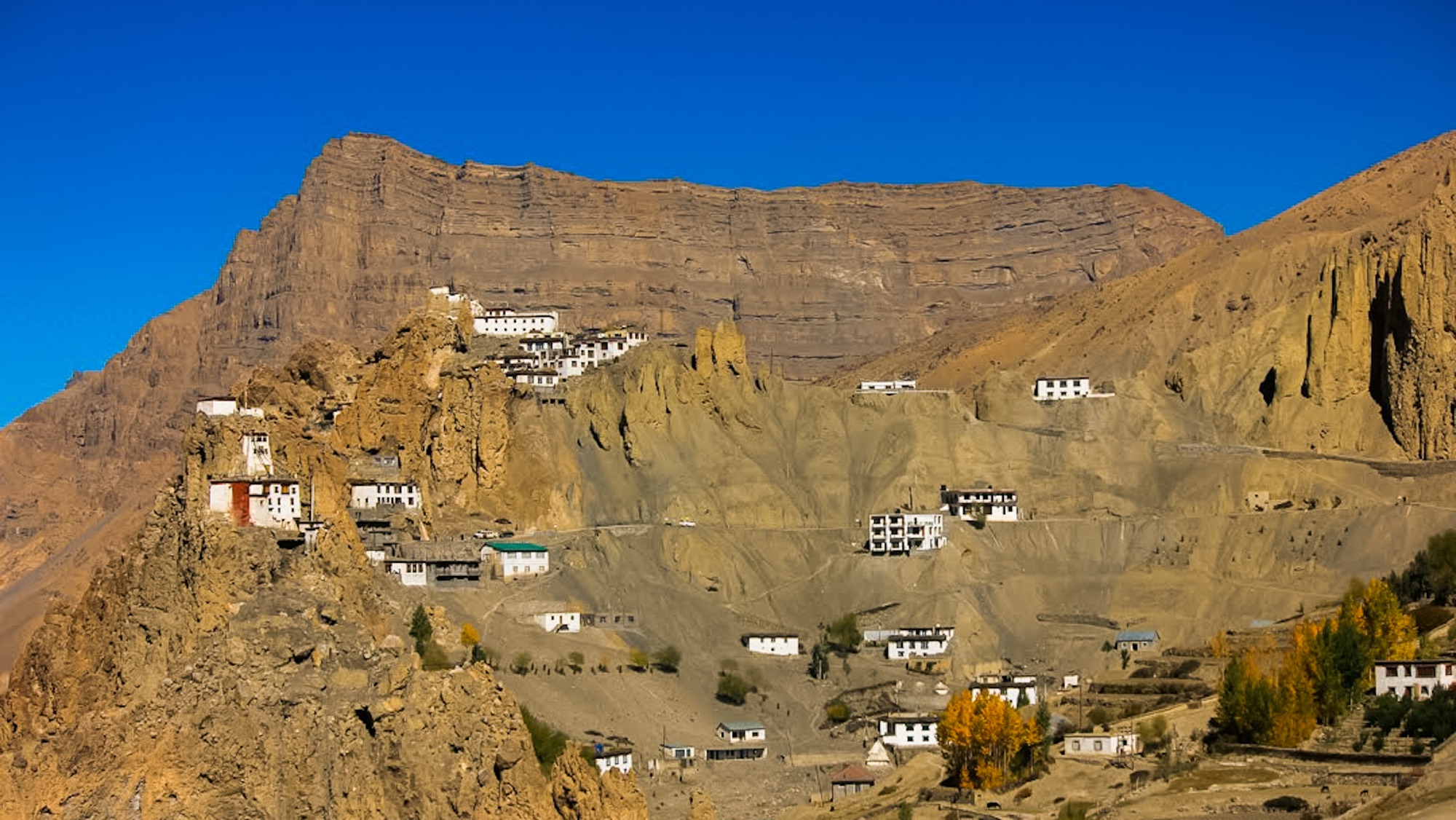
Some places don’t ask you to stop. They make you wonder how you ever thought of passing by, Dhankar is one such place.
Spiti has a peculiar way of making you question your idea of a settlement. You look at a cluster of houses perched on a barren mountainside, wonder how people came to live there in the first place, and then realise that these mountains have been home to generations long before the roads found their way here.
Dhankar – A Village Perched Above Two Rivers
Tucked between Tabo and Kaza, this ancient village sits dramatically above the confluence of the Spiti and Pin rivers. From a distance, its houses seem to grow out of the mountain itself, clinging to the rocky terrain as if they have made a quiet pact with gravity. The landscape is stark, almost austere, but there is something deeply reassuring about the way life carries on here.
Once the traditional capital of the Spiti Kingdom, Dhankar holds a place of considerable historical and cultural significance in the valley. Its name is commonly associated with a fort on a cliff, an apt description for a settlement that seems to have chosen one of the most unlikely places to call home.
And yet, that is the thing about the Himalayas. What looks inaccessible to an outsider has often been a perfectly sensible place to live for those who know the land.
Today, Dhankar remains one of Spiti’s most distinctive villages, with roughly 68 households and a population of around 300 people. Life here unfolds at its own pace, shaped by the mountains, the seasons and the quiet rhythms of a community that has learnt to make a home in a demanding landscape.
But beyond its history, its dramatic setting and its remarkable architecture, what stays with you is often something much simpler.
A conversation.
A Cup of Tea, A Taste of Local Life
Spend a little time with the locals, and there is always a chance that a casual exchange will turn into an invitation for tea. And if you happen to be offered some local flatbread alongside it, well, consider yourself lucky. There is something about chai enjoyed in a mountain home that no café, however thoughtfully designed, can quite replicate.
Perhaps it is the warmth of the room against the cold outside. Perhaps it is the unhurried conversation, or the fact that nobody seems particularly concerned about how much time has passed. Or perhaps it is simply the pleasure of being welcomed into someone’s everyday life, even if only for a little while.
As photographers and travellers, we often arrive at a place looking for its most recognisable frame. The ancient monastery, the dramatic cliff, the winding road, the mountains meeting the sky. We collect these views, frame them carefully and carry them home in our cameras.
But now and then, a place reminds us that its real character cannot be contained within a frame.
Beyond the Frame: The Soul of Dhankar
Dhankar is as much about its landscape as it is about the people who inhabit it. About homes that have stood through generations, conversations that begin with little more than a greeting, and a cup of tea that somehow turns a stranger into a guest.
And perhaps that is the best way to remember this old capital of Spiti—not merely as a place that once held political importance, but as a living village where history, landscape and everyday life continue to share the same narrow mountain paths.
Some places give you photographs.
Some give you stories.
Dhankar, if you let it, gives you both.
RELATED
कुछ और रास्ते जो सफ़र के बाद भी साथ रहे।
Travelogue · 20 Oct 2026
बागा सराहन की मोटरसाइकिल यात्रा | निर्मंड और पहाड़ी देवी-देवताओं की कहानी
Experience · 20 Oct 2026
लाहौल वैली का चाचा-चाची ढाबा : बातल में रुकना तो बनता है!
Travelogue · 20 Oct 2026